How Cheap Sunglasses Can Expose Your Eyes to More UV Radiation Than Wearing Nothing at All
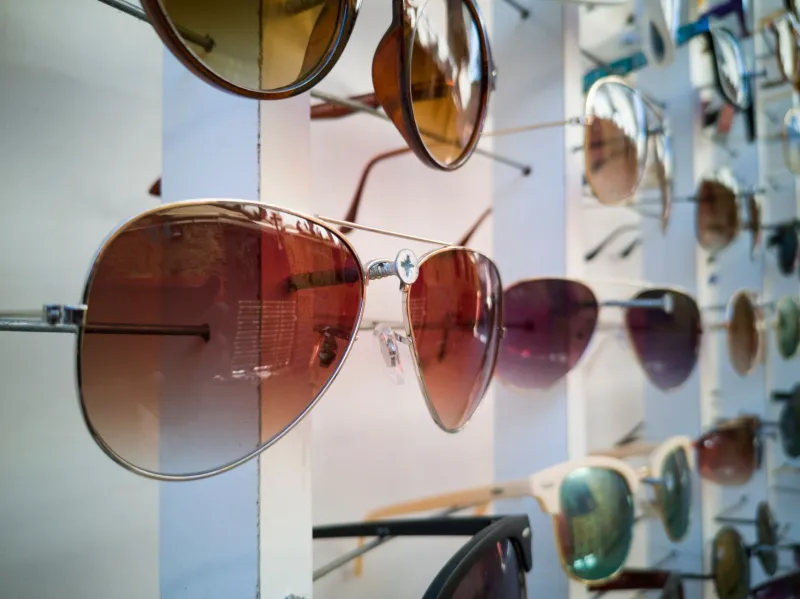
Most Americans approach the sunglasses aisle the same way they approach any accessory purchase: with an eye toward style and price. A pair of dark-tinted frames for $12 at the drugstore seems like a reasonable solution for a sunny afternoon. After all, darker lenses mean more protection, right?
Not necessarily. The relationship between lens tint and ultraviolet protection is one of the more consequential misunderstandings in everyday sun safety — and the consequences of getting it wrong extend well beyond a temporary squint.
The Pupil Response: Why Darkness Is Not the Same as Protection
To understand the hazard posed by unprotected tinted lenses, it helps to understand how your eye responds to light. In bright conditions, the iris constricts the pupil to limit the amount of light — including ultraviolet radiation — that enters the eye. This is an automatic, involuntary response, and it functions as one of your body's first lines of defense against ocular UV exposure.
When you put on a pair of sunglasses, your visual system perceives a reduction in ambient brightness. If those lenses are genuinely UV-blocking, this is entirely appropriate: less visible light is reaching your eye, and so is less ultraviolet radiation. But if the lenses are simply tinted — darkened to reduce glare without any meaningful UV filtration — your pupil responds to the reduced brightness by dilating. More of the eye's interior becomes exposed. And because UV radiation passes through the lens unimpeded, a wider pupil allows more of it to reach the delicate structures at the back of the eye than would have entered in the absence of any eyewear at all.
This is not a theoretical concern. Ophthalmologists have documented this mechanism for decades, and it is the primary reason that eye care professionals consistently warn against purchasing sunglasses based on tint darkness alone.
What UV Radiation Actually Does to the Eye
The eye is remarkably vulnerable to ultraviolet radiation, and the damage it sustains is cumulative over a lifetime. Different wavelengths affect different structures.
UVB radiation — the shorter, higher-energy wavelength most associated with sunburn — is largely absorbed by the cornea and lens. Chronic UVB exposure is strongly linked to the development of cataracts, the clouding of the eye's natural lens that remains the leading cause of preventable blindness worldwide. Acute, intense UVB exposure can also cause photokeratitis, sometimes called "snow blindness" — a painful, temporary condition analogous to a sunburn on the corneal surface.
UVA radiation, with its longer wavelength, penetrates deeper into the eye, reaching the retina. While the research on UVA's role in macular degeneration remains an active area of investigation, there is sufficient evidence to support concern about cumulative UVA exposure to the posterior structures of the eye. The macula — the central region of the retina responsible for sharp, detailed vision — is particularly sensitive.
Both wavelengths, in other words, warrant serious attention. Eyewear that blocks one but not the other offers incomplete protection.
Decoding the Labels: What "UV400" and "100% UV Protection" Actually Mean
In the United States, sunglasses are regulated as medical devices by the Food and Drug Administration, though the standards governing UV labeling are less rigorous than many consumers assume. The most meaningful designation to look for is UV400, which indicates that the lenses block all light wavelengths up to 400 nanometers — effectively filtering out both UVA and UVB radiation across their full relevant spectrum.
The phrase "100% UV protection" should, in principle, convey the same assurance, though it is worth noting that this claim is not always independently verified before it appears on a retail package. Purchasing from reputable optical retailers, established eyewear brands, or licensed opticians provides a meaningful layer of accountability that the discount aisle at a convenience store does not.
Lens color and tint darkness, it bears repeating, are entirely separate from UV protection. A pale yellow lens with a proper UV400 coating offers far superior protection than a deeply tinted lens without one. Polarization — a feature that reduces glare from reflective surfaces — is similarly unrelated to UV filtration, though many high-quality lenses combine both properties.
What to Look for When Purchasing Sunglasses
For consumers navigating the crowded and often misleading sunglasses market, a few practical criteria are worth committing to memory.
Seek explicit UV400 certification. This is the clearest, most standardized indicator of full-spectrum ultraviolet protection. If a label does not specify UV400 or 100% UVA/UVB blocking, the product should be treated with skepticism.
Consider lens size and wraparound coverage. UV radiation does not enter the eye only through the front of the lens. Radiation arriving from the sides — particularly at high angles of solar elevation or in reflective environments such as beaches, ski slopes, and open water — can bypass smaller frames entirely. Larger lenses and wraparound styles substantially reduce this peripheral exposure.
Do not equate price with protection. While many inexpensive sunglasses lack adequate UV filtration, price alone is not a reliable proxy. Some affordable options from reputable manufacturers do meet UV400 standards. Conversely, expensive fashion sunglasses are not guaranteed to offer superior UV protection unless explicitly labeled. The label matters more than the price tag.
Consult an eye care professional if in doubt. Optometrists and ophthalmologists can recommend specific brands or lens types suited to your lifestyle, geographic location, and ocular health history. Individuals with light-colored irises, a personal or family history of macular degeneration, or significant occupational sun exposure may benefit from additional guidance.
Children and UV: A Particularly Urgent Case
Children's eyes are disproportionately vulnerable to ultraviolet radiation. The crystalline lens of a young eye is more transparent than that of an adult, allowing a greater proportion of UVA and UVB radiation to reach the retina. Given that the majority of lifetime UV exposure is accumulated before age 18, establishing proper eye protection habits early carries genuine long-term significance.
Parents who purchase inexpensive, fashion-oriented children's sunglasses without verifying UV400 compliance may inadvertently be placing their children's ocular health at greater risk than if the children went without eyewear entirely — for precisely the pupil-dilation reasons described above.
A Final Word on Informed Consumer Choices
The sunglasses market in the United States is vast, varied, and inconsistently regulated. Tinted lenses are not UV-blocking lenses, and the distinction carries real physiological consequences. The counterintuitive reality — that the wrong pair of sunglasses can be worse than no sunglasses — is not a reason to forgo eye protection. It is a reason to be a more informed consumer.
Look for UV400 certification. Prioritize coverage. Verify claims. Your eyes are accumulating ultraviolet exposure across every decade of your life, and the structures they contain do not regenerate in the way skin does. The investment in genuinely protective eyewear is, by any reasonable measure, a modest one.