When Vacation Becomes Your Highest-UV Day of the Year: What Travelers Need to Know
The Ordinary Rules Don't Apply on Vacation
On a typical Tuesday in suburban America, your UV exposure is shaped by predictable constraints: a commute, an office, a shaded neighborhood walk, an evening indoors. Your skin adapts—or rather, it tolerates—a relatively modest and consistent solar load. Then you board a flight to a beach resort in the Caribbean, a ski lodge in Colorado, or a hiking trail in the Arizona desert, and everything changes at once.
The shift isn't merely psychological. It is measurably physiological. Research into UV exposure patterns consistently shows that leisure travel—particularly the kind involving warm climates, open water, or elevated terrain—produces some of the most intense and prolonged UV doses that ordinary people will ever encounter. And because these episodes arrive infrequently, the skin has little opportunity to mount even the modest adaptive responses that come with gradual, repeated exposure.
Understanding why vacations create this hazard, and how to manage it sensibly, requires looking at several converging factors that most sun safety advice simply doesn't address.
Why Vacation UV Is Categorically Different
You are outside far longer than usual. A person who spends six to eight hours on a beach is accumulating UV exposure that may exceed their entire previous week's total. This is not an exaggeration. Time outdoors is one of the strongest predictors of UV dose, and leisure travel is specifically designed to maximize time outdoors.
The environments themselves amplify exposure. Sand reflects approximately 15 to 25 percent of incoming UV radiation back upward, meaning you are being irradiated from below as well as above. Snow can reflect up to 80 percent. Open water surfaces add their own reflective contribution. Shade that feels comfortable may still expose you to significant scattered and reflected UV that you are not consciously registering.
Altitude changes the equation dramatically. For every 1,000 feet of elevation gained, UV intensity increases by roughly 6 to 10 percent. A traveler arriving in Denver from sea level, let alone hiking at altitude in the Rockies, is encountering meaningfully stronger radiation than their home baseline—often without any intuitive sense of the difference, since temperature and cloud cover can mask what the UV index is actually doing.
Latitude matters more than most people realize. Traveling from the northern United States toward equatorial destinations compresses the angle of the sun relative to the atmosphere, increasing the UV radiation that reaches the surface. A resident of Minnesota visiting the Florida Keys or Puerto Rico in June is not simply visiting a warmer place—they are entering a UV environment with significantly higher intensity than they have likely experienced all year.
The Baseline Problem: Unaccustomed Skin
Dermatologists often note that the skin most vulnerable to UV damage is not necessarily the fairest skin—it is the unaccustomed skin. Someone who has spent an overcast winter and a largely indoor spring suddenly exposing themselves to four to six hours of direct subtropical sun in early June has provided their skin with almost no preparation. There is no accumulated melanin response, no gradual thickening of the stratum corneum, no behavioral calibration built through recent experience.
This is the biological underpinning of what clinicians sometimes call the "vacation sunburn"—the severe, blistering burn that occurs not because a person was reckless, but because they underestimated how thoroughly their ordinary life had left them unprepared.
Why Protection Habits Degrade Precisely When They Matter Most
Vacation introduces a set of social and psychological dynamics that systematically undermine sun protection behavior. People are relaxed, distracted, and often operating without the routines that anchor protective habits at home. Sunscreen application that happens automatically before a morning commute becomes easy to skip when the morning begins with a poolside breakfast and no particular schedule.
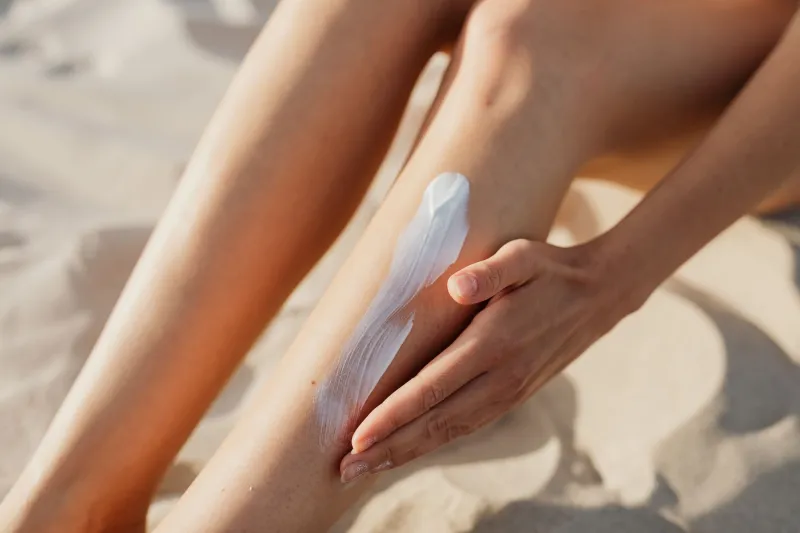
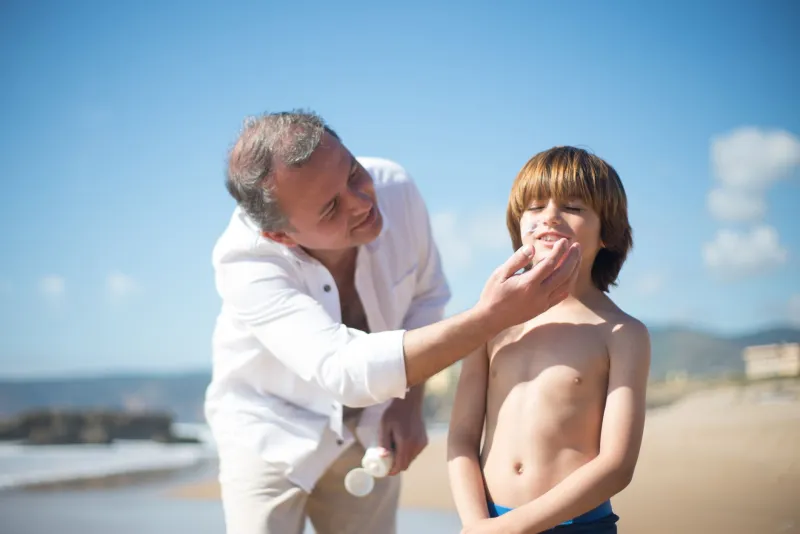
Reapplication is perhaps the most significant failure point. Sunscreen degrades with UV exposure, sweating, and water contact—and vacations involve all three in abundance. A single morning application, however generous, provides negligible protection by early afternoon under active beach or pool conditions. Yet reapplication rates during leisure travel are notoriously low. Convenience, forgetfulness, and the social awkwardness of pausing activities to apply sunscreen all conspire against it.
There is also the cultural dimension. In many American vacation contexts, tanning remains an aspirational outcome rather than a warning sign. The desire to return home visibly bronzed creates a motivation to minimize protection that is difficult to counter with statistics alone.
Practical Strategies That Don't Require Sacrificing the Experience
The goal of informed sun protection during travel is not to spend a beach vacation under an umbrella watching others enjoy the water. It is to make deliberate, informed choices that distribute risk more intelligently across the day.
Treat the hours between 10 a.m. and 2 p.m. as the highest-stakes window. UV intensity peaks during this period regardless of destination, and this is when behavioral adjustments—seeking shade, wearing protective clothing, scheduling indoor activities—yield the greatest return. Shifting water activities to the late afternoon rather than midday is a simple adjustment with meaningful protective value.
Invest in UPF-rated clothing before you travel. A long-sleeve rash guard worn in the water provides continuous, reliable protection that no sunscreen can match under active aquatic conditions. Wide-brimmed hats and UV-blocking sunglasses address the face and eyes, which are among the most exposure-prone and frequently underprotected areas during beach and outdoor travel.
Set a reapplication schedule and treat it as non-negotiable. Every 90 minutes to two hours under active sun and water exposure is a reasonable interval. Some travelers find it useful to tie reapplication to a recurring phone reminder rather than relying on judgment in the moment—judgment that is reliably compromised by enjoyment and distraction.
Research your destination's UV index before you arrive. The EPA's UV Index forecast is publicly available and geographically specific. Knowing that your resort location is forecast to reach a UV index of 11 on a given day—classified as "extreme"—allows you to plan accordingly rather than reacting after the fact.
Acclimate gradually on arrival days. The first full day at a new destination is often the most dangerous, because it combines peak enthusiasm for outdoor activity with the lowest level of biological preparation. Treating arrival day as a partial shade day, rather than immediately committing to maximum sun exposure, allows for a more measured introduction.
Protection as Part of the Plan, Not a Constraint on It
The most effective reframe for vacation sun safety is not one of restriction but of intention. A traveler who understands that their UV exposure will be dramatically higher than their baseline, who plans accordingly, and who makes a few deliberate adjustments to their schedule and habits is not sacrificing the vacation experience. They are extending it—across future years, with skin that reflects the care it received rather than the damage it accumulated.
Vacations are among life's genuinely restorative experiences. The science of UV radiation does not argue against them. It simply asks that you bring the same thoughtfulness to sun exposure that you bring to everything else you value.